The Associate Church
The Chartiers Presbytery of the Associate Presbyterian Church received a petition asking for supply preaching for this area in 1801. Records show that The Associate Church first met on the fourth Sunday in November of 1801. In 1803 some of those who were part of that community began meeting in the home of James Kennedy on “a farm adjoining the Warnock Estate to the left of New Castle Road and on the hill across the creek from Homewood.” That congregation met informally and with various supply pastors off and on until a congregation was officially formed about 1825.
Records recount the earliest pastor of the Associate Church in New Brighton. David Imbrie is described in this way in the history read at the 100th Anniversary of 1925:
It is said that Mr. Imbrie was a very large man, weighing over 300 pound; and when going any distance always took two horses. He would ride up to a house and get the inmates to assist him in changing horses, for if not careful, he would fall off on the other side.
Reverend John France settled in this area around 1819 to work with some other churches but began to hold services in the neighborhood. His preaching station began to grow into a congregation. This was problematic because this area was within the bounds of the Ohio Presbytery and he was supposed to be serving closer to Butler in the Chartiers Presbytery. It was considered an “encroachment” on the other Presbytery, but the resistance did not prevail because of the success of the blossoming church. Rev. France remained pastor until 1841.
In 1830 a house of worship was built near the brickyard between Grove Cemetery and the New Castle Road. The location is also described as being at the end of Fourth Street overlooking Grove Cemetery. This was the first church of any denomination to be built in New Brighton though the town of New Brighton was not officially formed until 1838. At this time, the church’s name changed to New Bethel, though the name “seceder church” was also commonly used. This church location later became a home. The building is also referred to as “The Church in the Wildwood.”
Thomas Kennedy in his letter for the 100th anniversary leaves the best description we have of that worship space:
To return to the old meeting house, the furnishings of the interior were of a very primitive character, to be sure there was quite a respectable pulpit at the end opposite the entrance, this was rather high and entered by steps on one side, but as to pews there were none, instead there were rough benches made of plank with holes bored at either end for the insertion of legs, a back made of a couple of slats running lengthwise, fastened to supports and rudely constructed ends. This seating served the purpose all the time that the congregation occupied the old church and was subsequently brought in to the new church on the hill at Tenth St. and was used there until a modern system of pews was installed. The only other furniture was a few chairs in front of the pulpit and the Communion tables and seating which later were stored in the left of the building through a small door above the entrance.
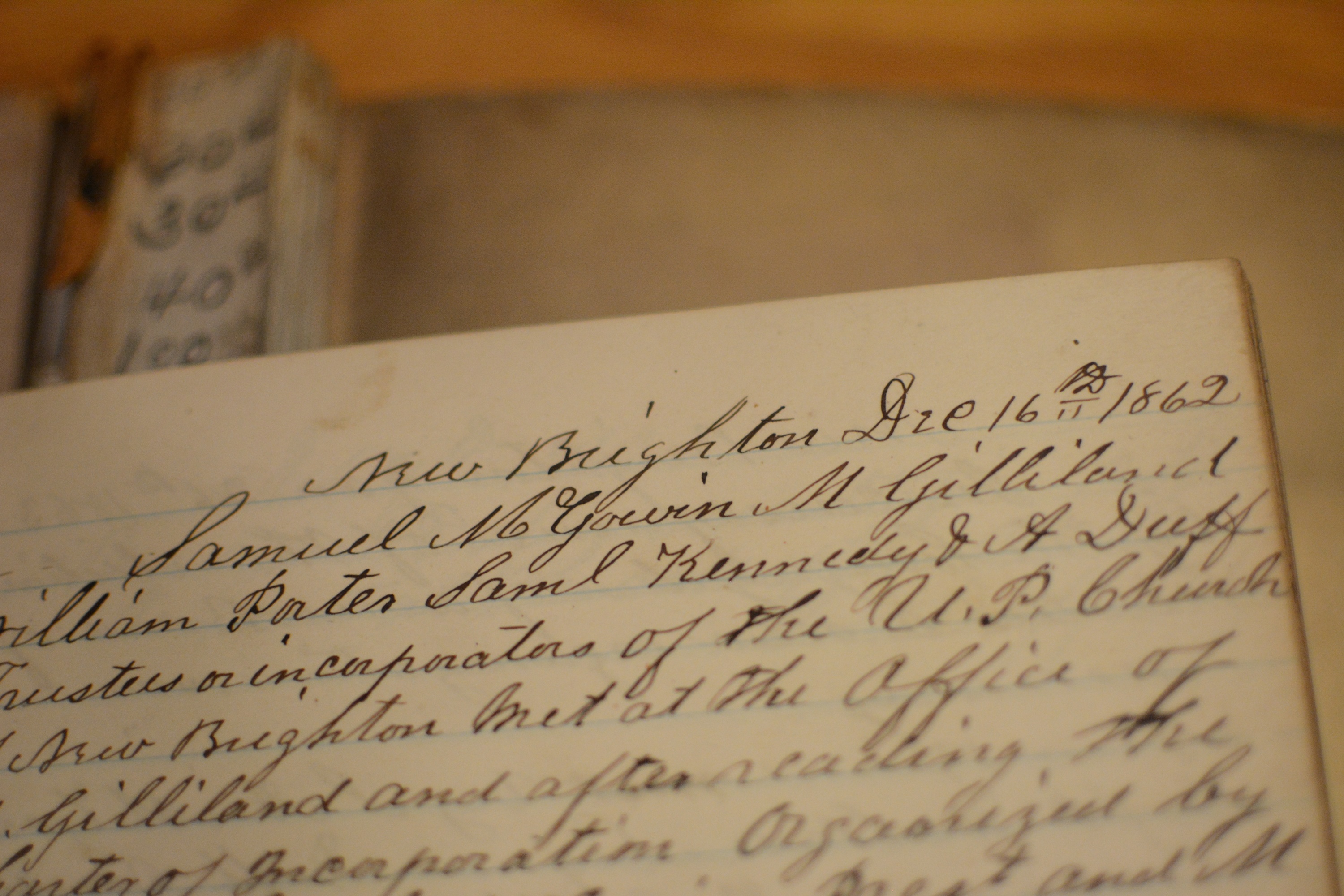 A second church was built by the Seceders north of Tenth Street at the top of the hill by 1859. At the time it was the corner of Tenth Street and Cherry Alley but it is now the corner of Tenth Street and Eighth Avenue. This church was known as “The White Tower Church” because it had a square white tower on the point of its roof. Started in 1854 and finished in 1858. It was a red brick structure and cost $2,700 to build including the lot.
The Associate Reformed Church
Preaching for the Associate Reformed Church began at the falls of the Beaver under a famous old elm tree that stood until 1880. This was at the foot of Ross Hill close to where the old Patterson Heights incline was located. At first they met in a tent in the summers for Bible study. In the winter they would move to James Patterson’s woolen mill that was located nearby. The church later met in in a school house in New Brighton where the Church of God stands.
In 1837 the church began plans to build their own worship space. They completed a building in 1840 on what is now Seventh Avenue and across from what was the Third Ward school house. Today it would be the block of Seventh Avenue between Sixth and Seventh Streets. It was brick and had a round roof so it was often called the “bake oven” church. It was later sold to the Roman Catholic Parish and later burned to the ground.
Churches Join
In 1858, at a meeting in Old City Hall in Pittburgh, PA, the North branch of the Associate Reformed Presbyterian Church and the Associate Presbyterian Church joined to form the United Presbyterian Church in North America. The churches had already begun to meet together sometime in the 2 years prior to denominational merger and they themselves merged in that same year. A group from the Associate Congregation rejected the merger and kept up their own gathering. In 1898 they purchased Grace Chapel on 13th Avenue.
Worship in the 1800’s
Worship looked and sounded very different in the early days of the church.
Because communication and travel were so difficult and because church was usually the center of social life, church was an all day affair with morning worship, a lunch break, and more worship in the afternoon. Thomas Kennedy recounts the Sabbath schedule:
With a congregation whose members were so widely scattered, and the means of communication so few, it may well be imagined that the Sabbath was an eventful day, not alone as the day for rest and worship but also as a time for social intercourse. The religious exercises consisted of two services each of generous length one in the morning and the other in the afternoon with an intermission of a half or three quarters of an hour between, affording time for a lunch and a season of social intercourse. In times of pleasant weather especially there was always a full turn out and it was truly the best day of the week anticipated and enjoyed by all.
Singing was a major part of worship, but functioned very differently. Not only were there no powerpoint slides, there were no hymnals. There were no bulletins and no instruments either. Songs were mainly Psalms with some hymns mixed in as well. A leader would have to stand in front of the congregation to share the lines and lead the tune.
The first organ for our church was placed early in the pastorate of Rev. Robert L. Hay between 1892 and 1911. In those days, organs had to be manually pumped with air while being played. The history from the 125th anniversary recounts the process to run the early organ:
As it was necessary in the early days of the instrument to pump compressed air from the bellows, young men in the congregation were engaged as official “pumpers…” As these assistants usually had a chair in back of the organ out of the view of both minister and congregation, on more than one occasion when the time came for the singing of the closing Psalm at the evening service, there would be no response from the bellow and the operator would be found to be safe in the arms of Morpheus. (aka asleep)
The sacrament of communion has always been important to Presbyterians. Many churches, including our own, took part in the practice of communion tokens. This practice was suggested in 1560 by John Calvin and Pierre Viret in Geneva under the thought that Christians should be prepared for communion. The fear was that people would profane the table if they partook without being worthy. The practice developed for elders to meet with congregants in the days leading up to communion. If you were found to be in good standing with regards to your faith and conduct, you would be issued a metal token. When you came forward for communion you had to bring your token and give it to an elder.
The history from our 125th Anniversary recounts the practice:
Preparatory services for Communion were held Thursday, Friday and Saturday afternoons and on the last named day the tokens, small pieces of metal, were given to those who were considered worthy to come to the Communion table. On Sabbath the members of the congregation, singing a psalm, filed to the tables, made of long boards and placed in front of the church and sometimes down the aisles, handing to the elders the tokens which had been given to them the day before.
The practice of communion tokens was discontinued during the pastorate of Rev. A.G. Wallace 1868-1884. During his time a new version of the Psalms was used for the first time. It was not until after 1890 that the communion elements were brought to people in the pews. Until that point communion was always served up front. During prayer, at least in the Sabbath School if not the church services, you remained standing. You would only be allowed to sit in case of illness
Moving to Third Avenue
When the two churches joined in 1858, they used The Associate Church’s recently finished “White Tower Church” on 10th Street. The church outgrew their 10th Street location, and in 1886 completed a building on what is now 3rd Avenue. At the time, Main Street (now 3rd Avenue) was the happening place to be. The Beaver Canal had followed along the river and eventually hooked up with the Erie Canal. The trade along the canal had pushed the creation and growth of river towns like New Brighton. When the canal opened in New Brighton in 1834 the town saw a boost in prosperity. The area downtown was where the commerce was and where the paved roads were.
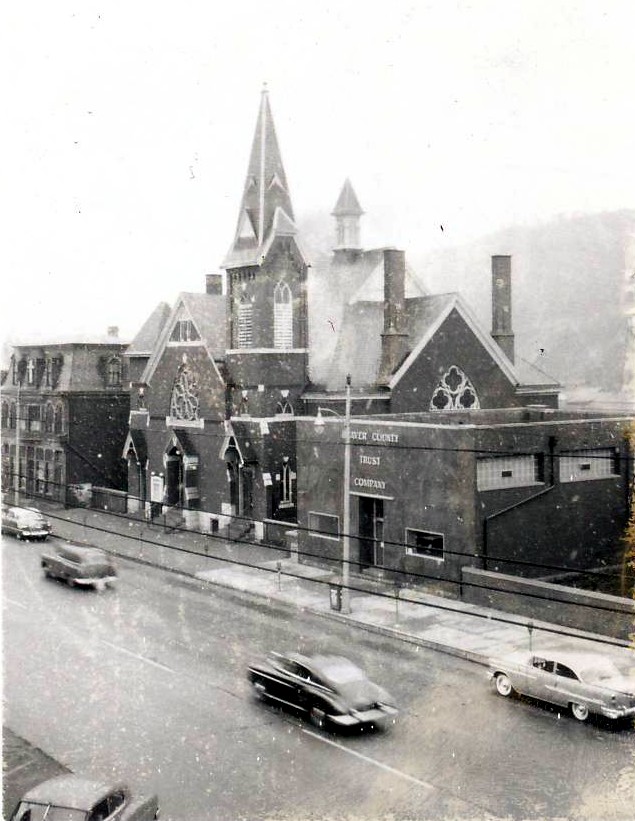 While the church moved in 1886 during the pastorate of Dr. William Barr, the plan to move had begun in 1870. The plot of ground was between what is now Under the Gun Tattoo Parlor (and McNutt’s) and First National Bank and was given by Matthew and Samuel Kennedy and deeded to the church by the Harmonie Society in Ambridge. Total cost of the building was $18,000 which was all pledged in February of 1887. When completed, it was considered one of the most modern and best equipped churches in the entire United Presbyterian denomination.
Several members at the time of this writing have fond memories of the 3rd Avenue location. The building was big for its time, with a sloped floor and individual seats. Early on the church had a big chandelier that was later removed. The prominent feature was the large organ pipes on the wall in the front of the church.
The kitchen was in the basement of the church but the parlor where events and dinners were held was upstairs. Food had to be carried up a flight of stairs. At some point the basement was dug out by hand to make the basement into a modern social area with a dining room, kitchen, and class room.
The church began looking for a new location in 1886. The building that had been so cutting edge was now old and in need of updates. There was little parking downtown and the street parking was shared by several churches. The church also wanted to move away from the railroad tracks that had replaced the canal. People can recall Sundays when a train would pass in the middle of the sermon and the pastor had to stop because he could not be heard.
During the research phase, the church also explored the name of the church. No record could be found in state or denominational records of the church officially changing its name to First United Presbyterian Church of New Brighton. Since the church was considering a location change they needed to firm up their legal name for property purposes. They decided to rename the church to Westminster United Presbyterian Church of New Brighton.
A Church Burns
October 20, 1963 was supposed to be an exciting Sunday. A committee had been visiting church members to secure pledges for the new church location and were prepared to share their results. But services were not held that morning. Around 5 am a fire began that soon engulfed Westminster. A Bible study that met on Saturday night worried that they had started the fire, but the fire began in Christner’s Bible Bookstore next door to the church.
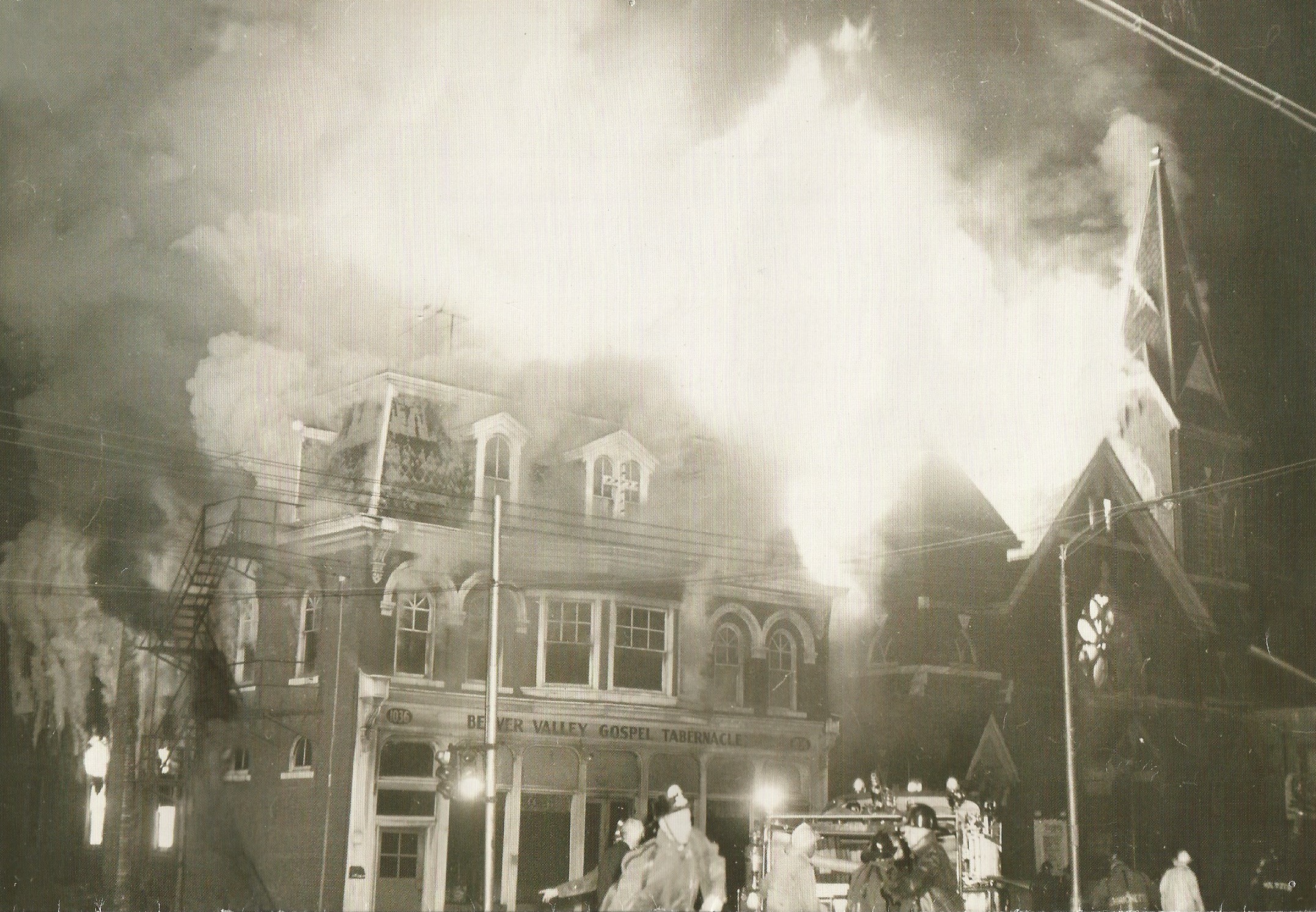 John and Don Hickey ran in before the flames got too high and grabbed several items including the pulpit Bible, a Bible holder, and the offering plates that we still use to this day. Don Hickey recounts that due to the heat the paint was peeling off the walls and it almost looked like it was snowing inside as it fell to the floor off the ceiling.
The session met on the corner opposite the flaming church and voted to hold worship at the New Brighton High School Auditorium that morning. One of the session members was on the school board and had access to the facility. After the service much of the church joined the rest of the community as much of New Brighton turned out to watch the fire. The fire was announced in all of the churches. Most members who were alive and in town that day can give you a firsthand account of the fire.
It took a lot of effort to get the fire put out. Essentially, it burned from the top of the building down. This left rubble in the church to catch fire again. Later that day the fire was restarted and the gas company continually checked the area.
In the end, the window prominent at the front of the church stood. Also left standing was a chimney that people had complained was not up to fire code. A sign that honored veterans of World War I was left warped. The church has a safe to this day that survived the fire and was removed from the rubble by a crane. The fire also left the cornerstone of the old building was exposed. Church members got to see a number of newspaper articles from the early church.
A Church on Oak Hill
Plans were already begun for the new building. Armed with the insurance money, the commitments from the campaign, and the motivation of keeping the church alive, the members got to work building on Oak Hill. Westminster originally purchased the property where Christian Assembly is now. Before building began, the property where we are currently located came up for sale.
 The church broke ground April 4, 1964. The cornerstone was laid July 26. The Steeple was put on the church on October 16. Many from town came to see the event. The steeple was built in once piece and had to be lifted by crane onto the 4 bolts that hold it up. The plates can still be seen on the ceiling in the sanctuary. The cross had to be carried by a person sitting on a bosun’s chair. It had to be screwed to the cables that run through the steeple so that it can act as a lightning rod for the church. There is a great newspaper article showing a picture of the raising of the steeple by crane almost a year to the day from another picture of a burnt steeple being taken down by crane.
Here is video of the church being Built.
The first service and communion was held December 6, 1964. The building was formally dedicated on February 14, 1965. From then on the church was totally located on Oak Hill with regular services were held in the new building. This is where Westminster is to this day. A special Watchnight Service was held on December 31, 1970. Church members worshipped together until midnight when the mortgage for the new building was burned.
The church property has continued to change as time has passed. The lot next to the church was purchased in 1999. That same year a set of hand bells were purchased. The bell choir was called the “Westminster Memorial Bell Choir” and nicknamed “The Ding-A-Lings.” A maintenance building was built on the property in 2001 to hold the tractor and other objects. The back entrance to the basement, which leaked when it rained, was redone in 2007. The Parlor upstairs was renovated in 2007 and nicknamed “the Westminster room.” Most recently, in 2011, Grace Mikita gave her home to the church so that it could be used as a parsonage. The home on Mercer Avenue just up from the church has been nicknamed “The House of Grace.”

Ministry Over the Years
Westminster has a rich history of diverse and changing ministries over the years. A great many lives have been touched and changed because of this church. As ministries lost their utility new ones rose up to take their place.
One of the most important ministries in Westminster’s history was the Sabbath School which started in 1848. When the modern ear hears this, they immediately associate the term with was would later be called Sunday School. The memory that most have of Sunday School is not as intense or organized as Sabbath School was. It was meant to be a school complete with a superintendent, committed teacher, and a developed curriculum. Pastor McLean was the first superintendent. Sabbath School would be a very important part of our church well into the 1900’s, with the officers prominently listed in the 125th anniversary history in 1950.
The Fallston Mission School was organized in 1882 and run by this church. There was a chapel building in Fallston on the hillside overlooking the 3 road intersection. This was the chapel for the school but also housed a Sabbath School that we oversaw. On Sunday afternoons kids from the neighborhood would come to this little house of worship called The Fallston Chapel to learn about the Bible. When it was torn down, some of the wood was used to build another building.
The Ladies Aid Society was started in 1870 for the purpose of raising funds for a new church building. This group used to sponsor oyster suppers, strawberry festivals and quilting parties at least once a week. They became a more social and informal group that worked to get the members of the church together. The group was later replaced by The Home Workers in 1899.
The Ladies Missionary Society was started 1877. Their purpose was “helping the poor and seeking to bring persons into the church.” They were especially valuable in creating boxes of goods for the freedmen. These were slaves freed after the Civil War who would come North looking for work and education. This society was still going strong at the 100 year anniversary in 1925. They also started Light Bearers which was a group for young children and the Junior Missionary Society for older children.
Over the years Westminster did other ministries as well. A prayer meeting was started in 1840. As was the practice, a number of members were split off from our church in order to start other churches in neighboring towns where they lived. Our church gave around 30 members for the start of Calvary Presbyterian Church in Beaver Falls. A group called the Y.P.C.U. was organized in 1885 as a young people’s prayer meeting.
Westminster’s ministry today includes the typical worship services and Bible studies. Vacation Bible School is always a blast in the summer. Since 1992 the church has had a children’s clothing ministry. Somewhere around 1995 Marilyn Householder led a group from the church began to make Apple Dumplings. These dumplings are a community favorite. Men have met for breakfast on the first Saturday of the month since 2002 for good conversation. In 2010 Westminster went on its first mission trip to Christian Children’ Home of Ohio in Wooster.
Westminster has had the opportunity to be light and hope to a great many people over the years. There have been 1,079 recorded child baptisms since 1868 with several known to be missing from the records. There have been countless weddings, funerals, dinners, counseling sessions, parties, and Bible studies.
For a complete history of Wesminster Click Here to download a PDF version.
 Westminster Church New Brighton